Tuesday, March 30, 2010

The Rhetoric of the New Atheism

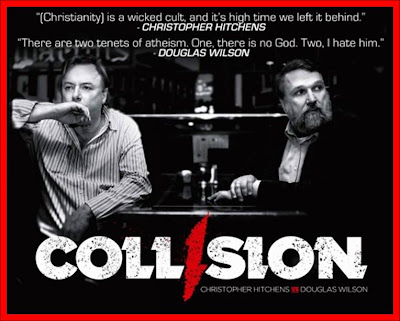
We're moving quickly through a unit in my AP Language classes that I've entitled "The Question of Worldview," inspired by our required text for the unit, The Question of God by Armand Nicholi. I am stepping out in faith today, by giving a chapter to the students, taken from Christopher Hitchens' book God is Not Great, with the intention of then following up with a reading of a Douglas Wilson article on the New Atheism. The next logical step is to watch the DVD of Collision in class, which is on the lesson plan for later this week. It's a great documentary (I think); definitely pick up a copy, or watch it if you get the chance. I heard they're selling it at Costco at the moment.

https://blogger.googleusercontent.com/img/b/R29vZ2xl/AVvXsEjKTRZYUW6zAz_yPcj7tCTJICv22rbdfXjm2DA8QAMLEIYiC5uz7abdZ32C6vI6TxbjqlS6mIs_vDUY9hNKfHEO5jzfi579OgRDvdn5i3j13f9rTzYEJLJgCMQgEmCRjUzMUCcsBajtf4ac/s400/Atheism,+atheist,+Christian+apologetics,+Christopher+Hitchens,+Doug+Wilson.jpg

As I've been reading Hitchens' book, I've been struck by his use of rhetoric (apropo for AP Language), and which I am discovering in much of the New Atheists' writing. Rhetoric: the art of speaking effectively, using techniques and tools to produce a specific response in the reader. Hitchens' draws eloquently on his vast reading experience, and weaves all his references together so well that he makes a compelling argument that conceals much of atheism's logical inconsistencies. These atheists are good writers, but the reader must beware of the persuasive power of the wordsmith.

Overall, I'm thankful for the chance to read/watch much from the New Atheism debate, at the same time I've been reading so much about rhetoric. It has really added a lot to my perception of those engaging in the debate, from both sides.

Tuesday, August 4, 2009

On Piper, on Lewis.


On desire, John Piper says this in a blog post from August 3, 2009:

"[...] all the debased enjoyments of the world are echoes of the joys of heaven. The analysis of this is worth a lifetime. And one effect of such an analysis would be to take the notion of “seeker-sensitive” ten miles deeper into Truth. How to penetrate the soul whose every desire is for Heaven while hating Heaven—that is the task."

Blogging about this concept of desire, Piper references the biography The Narnian about C.S. Lewis, and the references made in it to Lewis' own The Screwtape Letters. I love this idea of joy, and both Lewis and Piper have both been hugely influential in my own thinking as I have come to see this truth - namely, that every human desire is a desire for Heaven and for God Himself. Any desire, however big or small, is nothing less than this. Every good gift comes down from God, and is meant to reflect him like rays of light from the sun. As Piper says above, this should be stirring up in a Christian the desire to take unbelievers and fellow believers alike, ten miles deeper into God's Truth than we do. We need to pursue, and help others to pursue a joy in God Himself, because only He can satisfy.

Thursday, July 30, 2009

An interesting concept.

Rain, Rain Go Away...

Read this article on Britain's first "Atheist summer camp." The camp is backed by Richard Dawkins, author of The God Delusion, and is being portrayed as successful by The Times, and other British newspapers and magazines.

This is truly interesting, in-that these children being sent to this camp are learning about astronomy (and its differences from astrology), along with delving into other avenues of science. An atheist, however, denies his/her only basis for making any claim at all, whether about science or anything else. These poor children are being surrounded by a culture and environment at this camp that is striving to provide an enlightened view of life and the natural world; however, any claim or "truth" taught by these camp couselors and instructors is completely meaningless and carries no weight as these individuals have denied the existence of God Himself as the basis for knowing anything in the first place. The presupposition of the existence of the God of the Scriptures is so transcendent and necessary to any knowledge whatsoever, that even an argument against His existence must rely on that presupposition.

As always, we know that man is sinful at his core and will devise all manner of false explanations and excuses for how the world came into being, and for why evil exists, etc. God alone gives light to the eyes, and only the grace of God makes one able to turn from such things.

Praise God for truth.

And we know that the Son of God has come and has given us understanding, so that we may know him who is true; and we are in him who is true, in his Son Jesus Christ. He is the true God and eternal life. ~ 1 John 5:20

Saturday, April 18, 2009

The necessity of reading good books.

For a time lately (as is evidenced by my lack of blogging), I haven't been reading as much as I usually like to, for a variety of reasons.  I've just gotten back into the swing of things a little bit, and it is definitely refreshing.  I just finished Holiness yesterday, which should tell you how slow I have been getting through the books I have going.  

Reading sharpens my mind - I don't know about you but I think more clearly and definitively about God, myself, the world around me, and everything else, when I am getting a regular dose of some reading.  

Holiness has been good, and I will definitely be reading it again in the future (if circumstances allow).  

I have been plugging my way through Bleak House since Christmastime, in my attempt to eventually get through all of Dickens' works.  This is still a very enjoyable read 1/3 of the way through, where I am currently.  It's supposed to be one of, if not the best of Dickens - we'll see how it compares.  I haven't read David Copperfield, but some have said it's possibly the best of Dickens and I just bought a copy a few weeks ago to read over the summer.

    Back to theology, I've started reading a book that's been circulating around church lately - it's called A Gospel Primer and so far it's a very rewarding read.  In all its simplicity it's a very rich book, and a very convicting and encouraging one as well.

Adios.

Friday, February 6, 2009

Reading, always reading.

I have the privilege of being paid to read a lot, being an English teacher and all. Some of what I read ends up being just plain work, but much of it stays very enjoyable. I have lately had the blessing of reading several things that are making me think in some good ways. Here are the books:
1. Ephesians, and several commentaries on the epistle, all for our Bible study.
2. Holiness, by J.C. Ryle (yes, I will be finishing this soon). This has been one of the best Christian books I have read to date.
3. William Carey by S. Pearce Carey.
4. Lord of the Flies by William Golding (for my 9th graders) - I love this book.
5. Paradise Lost by John Milton (for my 12th graders) - also one of the best things I have ever read. This work gets better and better every time I come to it.
6. Dandelion Wine by Ray Bradbury. My wife and I just recently had the privelege to have Mr. Bradbury come to our library and speak, which inspired me to read more of his works. I had only previously read Fahrenheit 451, but now I'm finding I enjoy his writing more and more.